

The Challenge
Estuaries are among Aotearoa New Zealand’s most productive and culturally significant ecosystems, but many are under increasing pressure from sedimentation, nutrient enrichment, contamination, urbanisation and other cumulative stressors.
Existing estuary monitoring, typically based on sediment characteristics and benthic macrofauna, provides an essential foundation for assessing ecosystem condition. But important challenges remain. Can we detect ecological change sooner? Can we distinguish between the stressors causing degradation? And can monitoring provide a more complete picture of ecosystem health to support timely management responses?
Environmental DNA (eDNA) offers a new way to address some of these questions by revealing biological communities that conventional monitoring largely overlooks, including bacteria and microalgae that respond rapidly to environmental change.
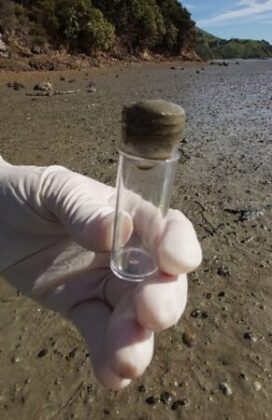
Transforming Coastal Monitoring Programme
Over the last few years years, Sequench contributed to the national MBIE-funded collaborative research programme Transforming Coastal Monitoring programme, Cawthron Institute and involving researchers, regional councils, iwi and hapū partners, environmental practitioners and international collaborators.
The programme addressed three key questions:
- Can eDNA improve our ability to detect ecological change in estuaries?
- Can it help identify the environmental stressors driving degradation?
- How can eDNA be integrated with conventional monitoring and mātauranga Māori to provide a more holistic and management-relevant understanding of estuary health?
The research brought together evidence from a national-scale manipulative estuary experiment, where 1,065 sediment eDNA samples were collected from 59 sites across 21 estuaries throughout Aotearoa New Zealand. Each sample was investigated using markers targeting bacterial, eukaryotic and microalgal communities, generating more than 3,000 community profiles across a wide range of environmental settings and stressor gradients.
What Did We Find?
The results provide strong evidence that eDNA is a practical and sensitive tool for estuary health monitoring. The key take home messages include the following:
- eDNA responds strongly to important estuarine stressors. Bacterial, microalgal and broader eukaryotic communities responded to environmental pressures commonly affecting New Zealand estuaries. Responses were particularly strong and consistent for sedimentation and metal contamination stressors. Responses to nutrient enrichment were also detected, but were more variable among estuaries and often non-linear, highlighting the complexity of diagnosing nutrient effects in naturally variable coastal environments.
- eDNA performed as well as, and sometimes better than, conventional biological monitoring. For sedimentation and nutrient enrichment, eDNA-derived communities showed sensitivity broadly comparable to conventional macrofaunal monitoring. For metal contamination, bacterial and microalgal eDNA communities showed stronger and more consistent responses than macrofauna. eDNA datasets also contained substantially greater biological diversity, often thousands of distinct sequence variants compared with around one hundred macrofaunal taxa. This provides a much larger pool of potential ecological indicators and increases the opportunity to identify stressor-specific biological responses.
- Bacteria emerged as particularly useful ecological indicators. Of the molecular markers investigated, bacterial communities characterised using 16S metabarcoding provided the most robust and consistent responses across the stressors examined. Microalgal communities characterised using rbcL marker also performed strongly and provide valuable complementary information. Based on the current evidence, 16S is recommended as the priority marker for routine estuary condition monitoring and future indicator development, with rbcL providing an additional option where resources allow.
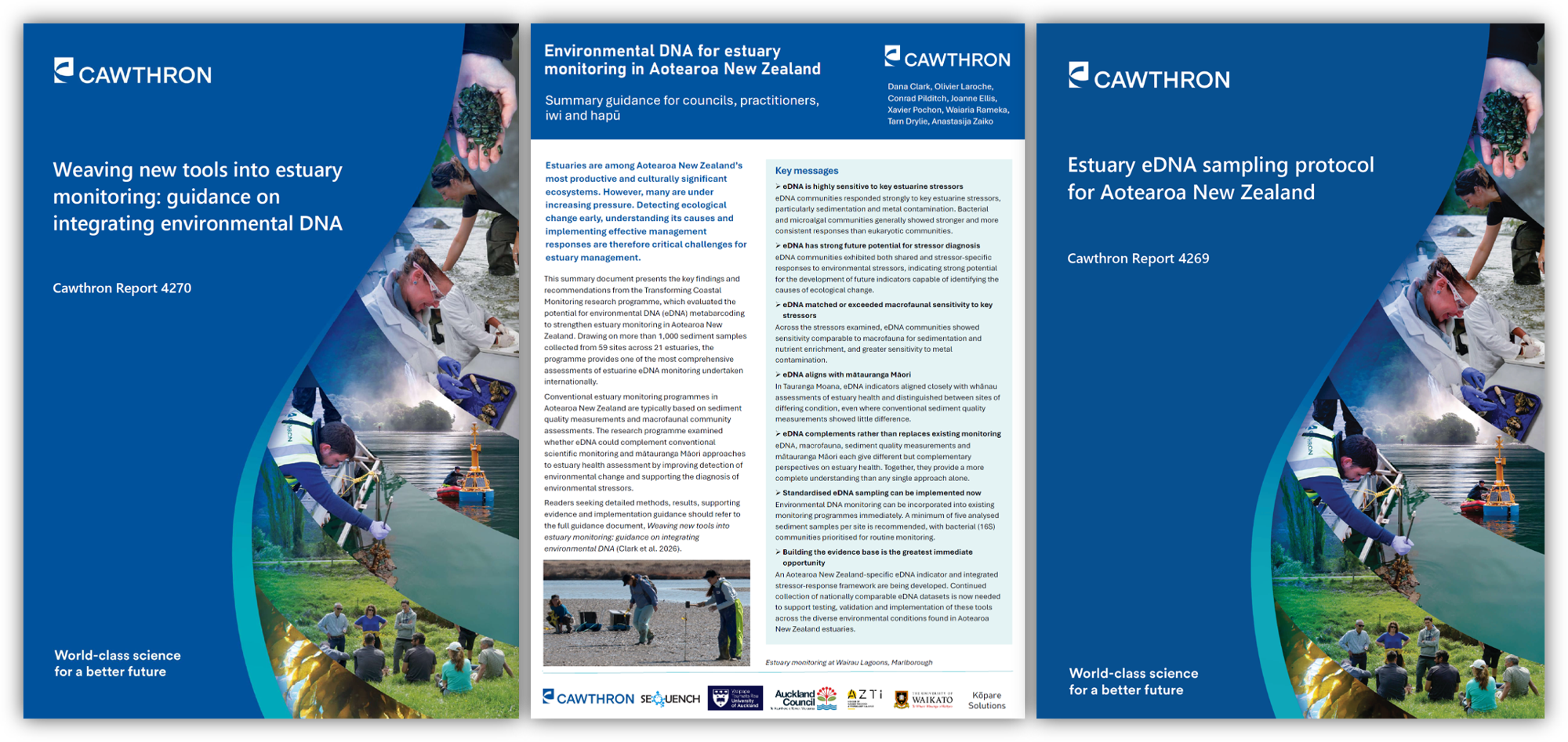
For more details on this research, check the published reports on “Weaving new tools into estuary monitoring: guidance on integrating environmental DNA” , “Estuary eDNA sampling protocol for Aotearoa New Zealand” and “Environmental DNA for estuary monitoring in Aotearoa New Zealand: Summary guidance for councils, practitioners, iwi and hapū“.
From Research to Implementation
A key outcome of the Transforming Coastal Monitoring programme is that eDNA is ready to be incorporated into estuary monitoring now, while more advanced Aotearoa New Zealand-specific indicators continue to be developed.
The research showed that eDNA provides a sensitive and complementary line of evidence alongside conventional monitoring and mātauranga Māori. In Tauranga Moana, eDNA-derived assessments aligned closely with whānau evaluations of estuary health, including where conventional sediment measurements showed little difference. At the same time, eDNA does not replace direct measures of organism abundance, size, condition or harvestability, nor place-based knowledge.
A standardised sediment eDNA protocol has now been developed for Aotearoa New Zealand, providing practical guidance for field sampling, laboratory analysis and bioinformatics. For routine monitoring, bacterial 16S metabarcoding is currently recommended as the priority approach.
The immediate opportunity is to build nationally comparable baseline datasets and integrate eDNA alongside existing monitoring. The next step is to develop and validate condition indicators, ecological thresholds and stressor-response tools that can help identify the causes of degradation and support more targeted management.
Join Us in Advancing Research
Do you have an innovative idea or a research question? We’re always eager to collaborate with passionate individuals and organizations. Contact us today to explore how we can work together to bring your vision to life and make a lasting impact on our planet.